1 March 2008 - 11:27Lifestream, but don’t tell me twice

With people barely having a thought we don’t in some way publish to the interweb there’s continuous chatter about information overload. I’ve always been of the opinion that I’d rather have all the information there was, leaving it up to me to pick what I wanted and what to ignore. It’s this that leads me to never ever getting my feed reader down to less than 2000+ unread items (most of these are flickr photos tagged “cat” or various vanity searches for my projects).

So, given that the background noise is of my own making, why would I complain about too much information?

Well I’m not complaining as such, I just think there needs to be a solution to the problem of getting the same information twice from different places. A technical one may do, but I’d rather a sort of moral code.

I’ve been thinking about this for a while, with people pushing their blog posts through their tumblr or twitter accounts, or into their Facebook posted items – this is information that I want, but I’ve subscribed to the blog I’ll find it there. It would be fine if the sources were just different ways of receiving the same content, but there’s other unique stuff mixed in - I like my contacts personal tweets, or their randomly tumbl’d web content, so I get the blog posts again. You end up skim reading everything, so I’m sure I miss things I’d like to have known.
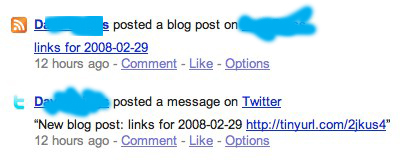
FriendFeed

I signed up for FriendFeed this week, more to claim my online identity there that through any desire to use it at the moment, but is it just another way to push the same content? ReadWriteWeb listed 35  ways to stream your life, albeit that some of them are rather hazy, I’m just thinking that I’d rather cherry pick what I care about from different people.

8 Comments | Tags: intenet, lifestream, noise, social media, social network, twitter, web, web 2.0, website

Comments:

  1. [...] dot com or a smart combination of both. This will make the Google Social Graph API and your information-overloaded friends very happy and reduce my online deja [...]

  2. [...] Lifestream, but don’t tell me twice [...]

  3. [...] Lifestream, but don’t tell me twice | jon bounds I guess this is what being made an example of feels like. (tags: friendfeed, twitter, blogging) [...]

  4. Don’t see the problem. Twitter is ‘what are you doing?’. Surely, “I just wrote something I think might be worth someone reading” counts?

    Don’t you just need your software to identify duplicates for you?

  5. bounder says;
    12 Mar 2008 - 7:46

    @Martin. I guess a software solution could work, although we’d be talking a complex system. Facebook, my IM software, twitbin, my rss reader and even my phone provider would have to work together, and also have some intricate natural language processing to decide whether these were automatic postings or the same content in different forms.

    Someone conversationally telling us that they’ve been thinking (and hence blogging) about a subject is a little different from a tweet in a facebook status informing of a automaticaly generated blog post of delicious links. (although I actually like delicious link posts, the context and groupings add something for me. )

  6. [...] whole problem is summed up quite succinctly by Jon Bounds in a comment at Cybersoc: The Facebook status, pulled from a twitter auto-announcing a blog post [...]

  7. [...] but the potential for things to go wrong is there. There are already alarm bells ringing - as Jon Bounds mentioned last month and Duncan Stephen just this week. While Jon proposes a moral code as some sort of [...]

  8. [...] Like me, she sees it a spammy, rude and a little needy. More people are making this moral choice to talk only when they’ve got something to say — which can only be a good thing. [...]

Add a Comment