Social web & social media, consultancy, training and advice from a flâneur of the internets. Blogger, writer, broadcaster and runner of Birmingham: It's Not Shit. I also do the odd bit of art.
September 29th, 2010

Is Birmingham Happy?

I’ve been running a, very rough, scrape of the Birmingham (UK) based interweb for ‘emotional wellbeing’ since April of 2008. Simply put a script running twice a day read in Tweets, news headlines and (originally) blog posts and compared the words within them to a table I’d drawn up of ‘emotion’ words and fairly arbitrary scores.

It was surprisingly interesting to watch: despite its roughness, the internal consistency let patterns emerge. It broadly followed weather and sports results, with some peaks and dips you could map to specific happenings, or news stories.

graph of emotion scores

It lead to a spin off focussing on Tweets from MPs, which I think influenced some of the developments that Tweetminster produced in the next year or so.

It was the patterns that lead me to keep putting off improving the algorithm, but recent Twitter API developments meant I had to do some work anyway and that (together with another project, of which more soon) gave me the impetus to give the project an overhaul. And here’s how it works now…

Twitter’s geolocation services are now much improved, so I can specify a point (the centre of Victoria Square in Birmingham) and a radius (10 miles) and get a reasonably accurate dump of Tweet data back—the algorithm calls for the most recent 1000.

Twitter is now the sole focus of data, in keeping with the ‘conversational pychogeography‘ aims of the project (in essence, words used without too much pre-meditation are more interesting than those written purely for publication). It also provides much more and more reactive data.

The words contained within these tweets are then compared to data from the University of Florida (The Affective Norms for English Words - PDF link). Within that data set each word covered (there are around a thousand in the set I’ve using) is given a score for Valence (sad to happy on a scale 0-10), Arousal (asleep to awake on a scale of 0-10) and Dominance (feeling lack of control to feeling in control  on a scale of 0-10). The scores are then collated and a mean calculated. The overall emotional wellbeing score here is calculated as a mean of the three individual means, although the scores are revealed individually on the site.

I’m unsure if combining the results in this way is the best, which is why the site reveals the working — the Twitter feed just goes with one value for ease of understanding and adds a rating adjective too:

if ($brumemotion<100){$rating="fantastic";}
if ($brumemotion<90){$rating="superb";}
if ($brumemotion<80){$rating="good";}
if ($brumemotion<70){$rating="okay";}
if ($brumemotion<60){$rating="average";}
if ($brumemotion<50){$rating="quiet";}
if ($brumemotion<40){$rating="subdued";}
if ($brumemotion<30){$rating="low";}
if ($brumemotion<20){$rating="dreadful";}
if ($brumemotion<10){$rating="awful";}

The Twitter feed produces results twice a day, and these scores are being saved to visualise more graphically, but the website updates every ten seconds (and will self-refresh if you stay on the site) and also displays a word cloud of the currently found ‘emotion words’:

is Brum happy right now?

Thoughts on further development

I’ve been experimenting with more local results (here is a version running on just one Birmingham post code — B13) as well as live graphing. I also have a version that will analyse results for a hashtag—something we may use in conjunction with the Civico player to produce ‘wormals’ (graphs of sentiment) during conferences.

But for now, I’m happy to let the new algorithm bed in—wondering about the amount of data and frequency that will be required to see the most detail—and to see what patterns we can spot.

Feedback welcome. Go see for yourself or follow on Twitter.

September 27th, 2010

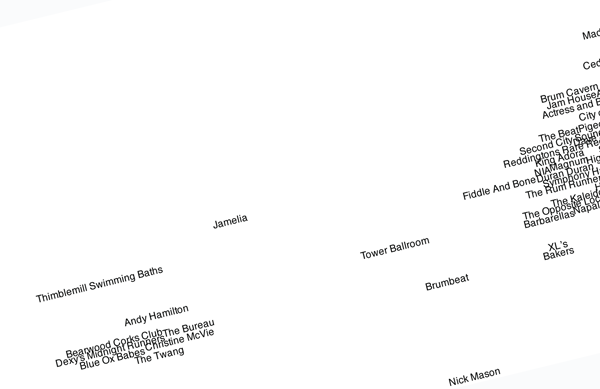
Birmingham Music Map

With the Birmingham Popular Music Archive I’ve been inviting the public to contribute to an online database of music culture in Birmingham, by placing venues, artists, people or anything they feel relates to music on a map. You can see and add your memories to the map, here.

Jon is a proper artist!

An editioning of the results so far was commissioned in the form of the Birmingham Music Map as part of ‘plug in’ an exhibition at mac curated by Simon Poulter. The exhibition has now finished, and the artwork (printed on toughened glass and around a metre wide by 1.4m high) is looking for a new home.  I’m happy for it to be displayed in any public place as long as they will display an artist’s card next to it and look after it — it would be brilliant if it was mounted somewhere appropriate, but if you’re interested please drop me a line at jon@jonbounds.co.uk.

If you’ve not got the room, poster/print copies are available, screenprinted on gorgeous white archival paper at B1 (707 × 1000mm /27.8 × 39.4in) in a signed and numbered limited edition of 100 copies.

Buy Now (£25 plus £5 postage and packing — recorded delivery):

Price for framed copies on application. Please email for details.

You can explore an online version here.

by Jon Bounds | Posted in art | Tags: , , , ,
September 24th, 2010

Loose Tweets Sink Fleets

WWIII Propaganda: Loose Tweets Sink Fleets

…or otherwise carefully crafted communications anyway.

If you’re newish to Twitter and attempting to communicate with people to achieve anything more than a way to update friends or follow people you like you might want to print this out and stick it close to your monitor.

This stuff doesn’t seem to be explained clearly enough by Twitter or people who are encouraging its use, based on the number of people I see trying to reach an audience and scuppering themselves a bit by making these mistakes:

Think Before You Tweet: People can’t DM you if you’re not following them. A tweet starting with a @username can only be seen by those following both of you. You can’t guess a username, a typo or no space after breaks them.

Once you remember, pass it on.

by Jon Bounds | Posted in good practice, twitter | Tags: , ,
September 21st, 2010

Mind Your Language

We’re all aware, or should be, of the power of language. It’s one of the central ideas of 1984, that you can direct or restrict thought by what words you use for real concepts.

If that doesn’t convince you—it’s fiction, right—here’s a real-life example of how language alters perceptions. This is a list of language changes compiled by the Institute for Government after consultation with members of the Conservative Shadow Cabinet and advisers. It shows changes in words and you can perceive shifts in policy. Some mean exactly the same thing, and within the organisations where this sort of language is in use everyone knows what they mean—but they’re designed to feel different and direct thought.

IN

OUT

Delivery/roll-out

Implementation

Investment

Spending

Demand side

Supply side

Top-down

Bottom-up

Target

Payment-by-results

Regional

Local

State

Society

Strategy

Business Plan

Evidence based

Principles based

Partnership agreements

Post-bureaucratic state

Stakeholder

Social Responsibility

Active centre

Departments

I’m not about to rant against jargon (I’m not a fan, but industry shorthand is almost inevitable) nor am I about to suggest that most people do this sort of thing consciously. This is just to illustrate the power of word choice in communications.

Now read this:

#localgov types really should follow @johnbarradell, B&H CEX and all-round good guy. #followThursday #Brighton

B&H CEX? I worked it out, but it took a while. A while I could have spent following the guy.

It's the private view for our Visual Communications MA students, and others, tomorrow. 6PM at BIAD Gosta Green campus, nr. Aston Uni.

So it reads like an invitation, but it’s to something ‘private’? Huh? Can I go?

I’ve worked out over a few years that “private view” means two things: if a show is big and important it means “no entry unless you’re invited”, if a show is small or not that well known it means “please come, there’ll be free wine and nibbles”. It’s developed as art-jargon for some reason, and people who know know and those that don’t don’t. But it does put off people who might otherwise have liked to have attended—and the smaller shows could do with that, in fact they want it.

So, just a reminder to think about the words you use if you’re trying to communicate—strip jargon and abbreviations where you can.

by Jon Bounds | Posted in good practice, twitter | Tags:
September 15th, 2010

Hyperlocal voices: Jon Bounds of Birmingham: It’s Not Shit

I was interviewed some time ago over email by Paul Bradshaw for a series on people who had started or were running (hyper-) local blogs. It's up now on Online Journalism Blog, and is the nearest I think I've got to the reason why I (at least) persist in this area — the other pieces give most of the other reasons by other peoples. [link]

by Jon Bounds | Posted in del.icio.us | Tags: , , , ,
September 10th, 2010

Mayors, badges, and blue plaques?

boundr

What’s Foursquare for? I think people are still working it out. While the benefits for businesses of being able to target customers and record movement are interesting (and would be much improved with widespread adoption), it’s harder to see just why people are using it. That’s not because I’ve got privacy issues (I do in fact experiment with Foursquare), it’s just that it’s a clumsy way to do most location based things.

Much has been said about the ‘game dynamic’, the badges and mayorships, but it’s a pretty simple and pointless game really. No rules to speak of, no way of easily judging performance, no winner–and horrendously easy to cheat (try logging in to the mobile.foursquare.com site on your computer, you can check in anywhere). My jury is still out on it.

What does interest me is the idea of leaving ‘tips’ at locations, not so much in the “great coffee round the corner” or “Order the special sauce!”–with illiterate exclamation marks–way, but real information.

This is just something I’ve been experimenting with with Michael Grimes, there’s hardly any information in it yet, and no real way to get it out. It’s an attempt at a syntax, and an encouragement to people to try to use these new locative tools to add information. There’s more here, but basically the idea is to add ‘blue plaque’-style information as ‘tips’ on Foursquare and the like.

There are plenty of sites or apps that do things such as overlaying Wikipedia information over maps, but this isn’t quite the same thing. The problem with Wikipedia for location specific information is the same that blue plaques have: namely invisible gatekeepers of what’s “notable” or “historic”. Civic Societies with arcane rules (eg. subject must have been dead for 50 years), or Wikipedia editors waiting to pounce on things without reliable, verifiable, sources make it hard for people to record history as it happens. And it happens in tiny, homely, ways that committees can’t record.

I’ve tried, jokingly really, to liberate the blue plaque before, but this online way might actually take off.

Blue Plaques

As a demonstration, I’ve knocked up this: a #bp map. It pulls tips from Foursquare that are tagged #bp and lays them on a Google Map. You can change the point of refference of the map by entering latitude and longitude as part of the URL:

http://jonbounds.co.uk/4sq/index.php?lat=52.4999&lon=-1.90001

But there aren’t, as yet, many more ‘plaques’ to look at –why not add a few?

by Jon Bounds | Posted in future web, geodata | Tags: , , ,
September 10th, 2010

Chernobyl Fallout

“What would happen if the world were suddenly without people; if humans vanished off the face of the earth? How would nature react —and how swiftly?” That’s the question asked by the documentary ‘Chernobyl Reclaimed‘, and the answer seems to be ‘it gets on just fine without us’.

I’ve been wondering if the social web doesn’t work in much the same way.

The social web, or to be more technically correct the social Internet has been around for a long time. USENET is over a decade older than the World Wide Web and though its appearance is something like a forum it’s a little more complicated than that.

It’s based on a hierarchy of groups, organised as something that we’d read like a domain name: sci.physics or alt.music.bjork or rec.music.dylan, users subscribe and their client keeps track of what’s read and unread. It’s not quite synchronous: the service or Newsservers that you subscribed to may only have taken a portion of the available groups and once you post it has to propagate through to the other servers.

That said, if you’ve used a message board or forum or Facebook discussion you’d be right at home — you can go off and try it now. Google Groups in part acts as a newsserver and you can subscribe to USENET groups and post via the web or email. You won’t find much action in most of them, and even those with fairly high post-counts probably aren’t as lively as the once were. I’ve just taken a look into uk.music.charts, a group I lurked in a little back in the ’90s and, while there are posts and the odd conversation thread, it’s about 60/40 with spam posts offering cheap watches, easy jobs and easy women.

One trusts that those still frequenting those groups have learned to live with the spam, they have good filters or a high tolerance— or perhaps, despite the hassle, still find the groups the best place for what they do and the community survives.

Spam isn’t the only reason to move on, of course,  and some of the more general groups have found discussion splintering, devolving and just going elsewhere.

I thought for a time that this might lead to a social Internet Gaia hypothesis: that the various systems on the Internet are ” closely integrated to form a complex interacting system that maintains the [economic] and [conversational] conditions in a preferred homeorhesis” to paraphrase the original. In short that the social aspect of Internet routes around blockages much like the data packets do.

In shorter: people move on if the space no longer works the best.

And they’ve certainly moved on from the group that is uk.local.birmingham (stared I learned the other day, by a friend of mine back in the early part of the 1990s). I still keep a subscription to it on the off chance, but from a 1999 high-point of nearly 3,000 messages a month it’s now dribbled down to about 20. Apart from spam, the only surges of activity are bile-filled back-and-forths somehow connected with sometime Birmingham ‘King of Clubs’ (with all that entails) Eddie Fewtrell. In any real terms this newsgroup has returned to nature.

And yet it’s still going.

uk.local.birmingham | Google Groups

The spam is automated, so it doesn’t know that it’s not reaching people. The website (in my case) and newsservers don’t know that the traffic isn’t human so they continue to serve it. Those few real subscribers either no longer use the email addresses they signed up with, can’t be bothered to unsubscribe, or have long since filtered the responses away. Or they’re me—too sacred to mis anything—or the blokes whose ’70s territorial spats are best  conducted from the safety of a kitchen laptop. With Smooth FM on.

The Internet doesn’t care who or what is using it, it just bats content around. People set things up and then leave, it still carries on. How many services have you set to autopost, or synced with newer or better spaces and then sort of stopped using?

If every real person left Twitter tomorrow, like some dystopian novel (the film would be terrible), Twitter would carry on. As long as someone was still paying the server bills: pumped in Facebook statuses would still be posted, Foursquare mayors would still be declared, ‘news’ from thousands of company sites would be Twitterfeeded (or similar) to a gasping lack of public. And bots would generate new, Twitter only, content some silly, some aggregated, some spam.

The words ‘New Blog:’, ‘Breaking’, and ‘I am Jack’s colon.’ would still appear, and a lot of those posts would be shuffled off to Identi.ca or even some Facebook statuses. Autopost is the weed that would grow over our cities, spam is the animals slowly taking over. Our social web Ghosts in the Hollow.

In a way this already happens, there are thousands of social web accounts that exist purely to exist: automatic and unweeded, they either spam or have been set up and discarded. The amount of companies ‘talking’ to each other on Twitter is amusing to behold, often set up on a whim and operated from another service (usually Facebook) the accounts Tweet— but really that’s all that’s going on.

I was alerted to a local shopping mall being ‘on Twitter’ the other day, it’s been ‘tweeting’ for nearly a year. Following’ (despite never, it seems, logging into Twitter or dealing with @messages) 114 and being followed’ by 126 accounts. 90% of both of those numbers are other organisations tweeting nothing in much the same way, or people who work for those organisations. The account is a bot, talking to other bots and doing nothing except perhaps disappointing anyone who did want to engage with them.

The weeds are poking though even in fairly well ‘Liked’ Facebook pages too. Facebook page spam is on the increase, leave your page unattended for a day or so and if it’s popular enough to have attracted the attention there will be Russian brides and pyramid schemes posting. If it’s a page you created for fun, fair enough. It’s all about effort and no-one will think any less of you—but if it’s your work, I think you owe it to whoever you’re trying to talk to to care a little more.

Facebook | Birmingham: It's Not Shit

What can you do? Think carefully about what you automate, close or mothball old and unused profiles and pages. The usual stuff you’ll never get round to doing.

Twitter, reportedly, has about 3% of it’s servers at any one time full of Tweets about Justin Bieber. That’s some power of stardom, but think about it: how many of those accounts are autoposting to Facebook (or vice versa)? That’s 3% of Facebook’s severs too. And ping.fm’s and mySpace’s, perhaps. Maybe 1% of the Internet?

I’m guestimating to the point of losing all thread of argument, but the ecological consequences of auto-posting to dead services is probably fairly significant. We could be sucking the planet dry with our automated laziness.

But the animals and plants will do just fine.

September 8th, 2010

Subject: Act now to get the best communication from your Elected Representatives

Dear Sir or Madam,

I'm writing to you to ask for your support in helping work out how our elected officials can deal with online campaigners. If we don't act soon then the opportunity to create huge grassroots movements will be marked as SPAM.

I’ve been thinking more about the hoo-ha when new Tory MP Dominic Raab was being vilified for his attempts to make sense of his Parliamentary inbox. He claims automated online lobby groups are creating too much correspondence to deal with in a meaningful way—and while attempting to hide his email address wasn’t the right way, he’s got a point.

His big moan was directed at fairly new group 38 Degrees, who were very active during the election, who he claimed at some points were sending 200 “cloned” emails a day. He said:

“Look at why 38 Degrees took on that title – it is the angle at which an avalanche falls. Their aim is to create an avalanche in MPs in-boxes. Others apply the same tactics, so spam filters won’t solve it – that is why I want the right to opt out of them using my email for those purposes”

Subject: Act now to get the best communication from your Elected Representatives

Dear Sir or Madam,

I'm writing to you to ask for your support in helping work out how our elected officials can deal with online campaigners. Causes that have most to gain from demonstrating mass support need to makes sure that power isn't diluted.

Tom Watson MP has experience of this, being deluged by emails even when he was on the same side as the lobby group—and that’s part of the problem, the mass campaign tools have quickly worked out how to match you to your MPs email but opinions on policy aren’t easy to automate. Even if they did, that’s not how people work—the nudging actions on the social web mean that people will want to press send to “do their bit” and join in. Clicking on that button is too easy to require much thought.

The emails are a problem because the accepted wisdom is that direct communication requires a response. The problem is no longer establishing the communication, but managing it. These emails are very like a petition, but one with the proposal very so slightly personalised by the signatory so requiring a separate response.

Subject: Act now to get the best communication from your Elected Representatives

Dear Sir or Madam,

I'm writing to you to ask for your support in helping work out how our elected officials can deal with online campaigners. We must look for ways to harness that nudge power to produce real actions as well as acts of me-too-ism, or else we're just building complicated petitions.

Maybe we need to mature a little and be realistic—if communication takes minimal effort then it must deserve appropriate effort in response. We can’t expect the same response to an automated email as we would to a bespoke email or conversation—but does that mean we’re back to petitions?

Petitions give a central point of contact and collate strength of feeling, but are binary — you have to agree with everything the petition says, there’s no conversation or discussion. I might think that more research is needed into triage-by-phone services, but petitioning I can either “save” or “shut”.  They can easily be dismissed if the petitionee is of a mind—you can pick holes in the most tightly worded statement, and what then? Do it all again?

We’ve fallen out of love with petitions, local authorities were obliged to build online petition sites just over a year ago and in Birmingham at least nothing much has happened. The site cost £7,500 to set up followed by an expected annual running cost of £1,332 but it’s not exactly been inundated by petitions or signatures. In a year, in an authority area of over a million people there have been only 29 petitions submitted, of which a tiny 19 made it to the website (from this FOI request)— only two seem to have got responses (both of which say ‘thanks but no thanks’ pretty much). At the time of writing there are just four live petitions, none of which have any hope of affecting policy.

Subject: Act now to get the best communication from your Elected Representatives

Dear Sir or Madam,

I'm writing to you to ask for your support in helping work out how our elected officials can deal with online campaigners. Because they've got to learn that it isn't working too.

I’ve lost count of the number of emails I’ve received during the Labour leadership campaign, I’ve checked it wasn’t a real email from an Ed, or a Miliband or one of the others (unlikely, but possible— the giveaway is that only auto databases ever use my full name), skimmed and deleted. In some cases I’ve thought “I’ll read that later”, but I don’t think I have—because email isn’t a persuasive medium, particularity at scale. When the size of your email mailing list is important it’s because you have a list of supporters, some of whom will respond to requests or calls to action. Hitting the unconverted just blends into the SEO emails and the random, bizarrely rich, Nigerians.

Subject: Act now to get the best communication from your Elected Representatives

Dear Sir or Madam,

I'm writing to you to ask for your support in helping work out how our elected officials can deal with online campaigners. Your heart pretty much always sinks on the receiving of another email doesn't it?

Think before you hit send, are you contributing or SPAMming?

by Jon Bounds | Posted in social media | Tags: , ,


Powered by Wordpress using the theme bbv1 Content © Jon Bounds